
Back in 2004 I learnt a valuable lesson that would serve me well if I wanted to broaden my diving horizons: You’re only an accomplished diver in environments you have actually accomplished diving in – diving expertise does not always travel well.
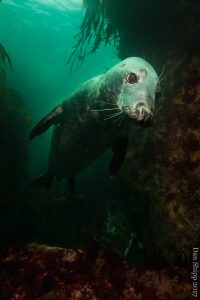
Below is a short account of the trials and tribulations of learning to appreciate dry suits, peppered with a few unrelated photos taken over the past 15 years in UK waters, happily housed in a dry suit. Enjoy.
Confessions of a kelp monster

When I came back to the U.K from being a warm water divemaster in 2004, the sea was still coursing through my veins. Pretty quickly I realized that a few stolen weeks of holiday from the civil service every year was simply not going to be enough to satisfy this desire. The next thing I knew I was trying on a dry suit and going for a dive with some instructor buddies to put me through my paces.
‘I am used to diving every day and that feeling of pleasant euphoric weightlessness has to be the same the world over, surely… How different can it be?’ I wondered.
Very different, it turned out.
Even before I was wet, just lugging the gear to the edge of the pier was enough to get a sweat going and conjure psychedelic colours in front of my eyes. Or perhaps that was because I felt like I was being mildly strangled – as if a small child was hanging off my neck. I was red. My neck veins were throbbing and I was certain that my blood starved brain wouldn’t cope with this for long above water, let alone on a dive. “You’ll get used to that.” I was reassured. “If it’s too comfy you’ll end up with freezing seawater down you” I was then told. Hmm, the 7mm wet suit started to seem more appealing than this dry suit lark after all. Isn’t part of diving about actually getting wet? Apparently not anymore…
Once we got underwater things didn’t improve. The first issue was an all encompassing feeling of being a vacuum packed haddock, especially in certain areas that very much enjoy ‘hanging free’. ‘OK, I can tackle that’ I reasoned (pardon the pun). Dry suit inflator valve opened, and ‘ahhhhh’ – problem indeed solved. I would have to learn to incorporate my drysuit airspace AND my BCD bladder AND my lungs into the whole buoyancy equation. This is different. Very different.
It soon became evident that the concept of movement and freedom is also very different in a dry suit. I am used to being able to easily reach any part of myself or my equipment, but this sheer bulk was something new.
With neutral buoyancy established at a shallow depth and friends close by, I took my chance to experiment. I tried to reach my fin straps. This is a pretty common point of failure so I wanted to be aware of how it felt to adjust them in this medieval suit of armour – sorry – I mean state of the art tri-laminate drysuit. It’s pretty easy in tropical water… How different can it be?

My first attempt was a pitiful flailing effort, resembling the Michelin man attempting to do up his shoe lace – failure. I was evidently going to have to bring my foot up as well as bending my body down. Second attempt – success! I now had access to the length of me and it felt good. I was becoming one with my equipment and surely on my way to growing my U.K. gills, yes!
But hang on, No… Something was suddenly very different. No sooner had I mentally patted myself on the back for the simple task of reaching my ankle, but I was aware that the air bubble in my dry suit that was previously evenly spread across my body – keeping me flat-ish – was now accumulating at my feet. This left my chest and shoulder area in a tightening vacuum packed ‘squeeze’ and also left the small amount of water in my mask free to explore the depths of my nostrils, which is fairly uncomfortable. But most critically, it left me comically hanging upside down with a look of utter bewilderment on my face.
I had in fact been warned about this and told that righting one’s self from an upside down position is a critical skill. This involved more Michelin man-styled tying of shoelaces, which is actually somewhat tougher when you’re hanging in the water starting to giggle at the whole event.

I eventually managed the spin, and then repeated it a few more times to get more comfortable with it. The serious side to being upside down in a dry suit is that the air in your dry suit can no longer escape via the normal routes, usually via a dump valve found on the cuff or the upper arm. Managing this highly buoyant air is key to controlling your position in the water and preventing runaway ascents. Most people new to diving have a fear of sinking, but very quickly you learn that it’s the coming back up which needs real care and attention.
The remainder of the dive was a matter of acclimatising to a lack of movement, a lack of warmth and most importantly a lack of ability to have a wee without sloshing around in it for the rest of the dive (oh how simple that joy is in tropical water!).
Yes, it’s cold, yes it’s dark, and yes, U.K. sea dives are frequently called off because the weather does not always behave. But despite ALL that, yes, it’s a small price to pay to unlock a door to an incredibly rewarding marine environment. The colours are splendid, the species are jaw dropping and the terrain is truly beautiful.
For me, nothing equals the emerald glow of sun light as it radiates through kelp. It provides an amazing spectacle, a playground, a nursery and a thriving habitat for the marine life that lives among it.
Even as I type from my spot next to crystal clear Indonesian reefs, I find myself actually looking forward to my next dive at Chesil Beach in Dorset , and Porthkerris in Cornwall, and the Farne Islands in Northumberland again. Yes, give me murk! Yes, give me silt and gloom. I am a cold water kelp addict and proud of it!